 |
| a home away from home |
| FEEDBACK TELL A FRIEND WEB SITE DESIGN CAREER WITH US CONTACT US |

 Festivals
Durga Puja
Associations
Learn Bangla
Beng. Marriage
Baby's Name
Art & Craft
Great Indians
Beauty Care
Recipe
Astrology
Beng. Section
Bengal
Calcutta
Tiger
Beng. Calendar
Wallpapers
Movie
Music
E-Card
Shopping
E-Puja Room
News
E-mail
Month's Events
Weather
Chat
Travel
Join Us
Advertise
Website links
Link to us
Guest Corner
Services
WebSite Design
 Bankura's
horses
Bankura's
horses
 |
The logo
of All India Handicrafts is the Bankura Horse. These horses display the
skill and craftsmanship of Bengal.A pair of terracotta horses in a corner
of a room adds class to any Bengali living room. These horses are not
just decorative artifacts, but they also display the skill and craftsmanship
of Bengal. Tracing back to the history of the terracotta sculptures, we
land up in the land of red earth, the district of Bankura in West Bengal.
The Malla rulers |
of Bengal played an active role in developing the intricate works of terracotta over the years. In 1655 they built Jor Bangla and Shyam Rai in 1640, which reflect the Vaishnav
culture. Terracotta figurines of animals and birds along with geometric
panels and historical depiction of the love between Radha and Krishna
were the subjects of these architectural splendours. After 300 yrs
the structures are still as it were before because of the scientific methods
used in building it. Bengal
clay pottery can be divided into two segments-Bankura Clay Pottery and
Krishnanagar Clay Pottery. Bankura's art form is an ancient form than
the art form of Krishnanagar. It was the Kumbhokars or potters of Panchmura,
16 miles away from Bishnupur, who started to make the famous Bankura horses.
If looked closely it will be noticed that the Bankura |
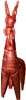 |
horses have more
erect neck and ears and
look more dynamic. Their jaws are wider, their set of teeth can be seen,
eyebrows are drawn and their forehead is decorated with Chandmala.
Making
of the Horses:
The 4
hollow legs of the horse is first made followed by the torso and then
the neck and the head. All these parts are separately made and then glued
together. On drying they are coloured and burnt in the kiln. These horses
are of different sizes ranging from 6 inches to 4 feet. Biboda, Kamardiha,
Bishnupur, Jaikrishnapur, Nakaijuri, Keyaboti are some of the
places were terracota horses are made regularly.
Horses
used for Puja:
Horses made in Sendra are worshiped. These horses are not hollow but solid. Bankura's
local God Dharmaraj is another form of Sun God and mythologically it is
known that Sun God is the rider of horses. Thus horses form an important
part of all rituals while performing puja. Besides terracota these artistic
horses have been casted in dokra and wood because of the growing demand.





GREAT INDIANS || BENGALI SECTION || BENGALI MARRIAGE || BABY'S NAME || WALLPAPER || BENGAL || WEATHER || TRAVEL
MOBILE WALLPAPER || E-CARD || MOVIE || WEBSITE LINKS || ASSOCIATIONS || SHOPPING || ASTROLOGY || MUSIC || BEAUTY CARE
TIGER || NEWS || GUEST CORNER || FEEDBACK || LINK TO US || FOR ADVERTISING || SERVICES || CONTACT || BENGALI CALENDAR
Graphics, Sound or content copied or produced in part or whole in any media will be illegal.
Persons or websites caught using our material will be penalized.
Privacy Statement || Copyright
Copyright ©1999-2014 BANGALINET.COM


