 |

|
| a home away from home |
| HOME FEEDBACK TELL A FRIEND WEB SITE DESIGN CAREER WITH US CONTACT US |

 Traditional Durga Puja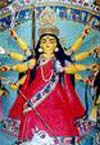
The origin of Durga Puja dates back to the days of the Mughal Empire in the 16th century. Worship of the Goddess Durga had taken a social turn since the bygone days.The large scale celebrations, the grandeur, and the fan-fare were a part of the Puja even when Raja Kangshanarayan of Taherpur or Bhabananda Mazumdar of Nadiya organized the first Sharadiya Durgotsab in the year 1606. Soon Durga Puja became the great annual festival bringing family, friends and neighbours
together. It became a religious extravaganza among the Babu's of Bengal. Though it had become the yardstick simply to measure the supremacy of one over the other, there were traditional household Durga Pujas too, which gained prominence because of their deep devotional fervor.Some of the significant traditional Durga Puja were
Sabarno
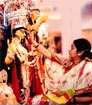
Raychoudhury's family Durga Puja at Barisha, Gobinda Ram Mitra's of Kumartuli,
Krishnadeb of Sobhabazar, Mitra Family of Chorbagan, Srimani family
of Sukia street, traditional Durga Puja at Rani Rashmoni's residence and
Kaliprasanna Singha's household Durga Puja.
Cultural shows like "Jatra", Puppet Dance, "Kobi Gaan",
"Kirtan", Magic Shows were put up to enhance the attraction
of the festival. Some of the traditional household Durga Puja even dates
back to 200-250 years. Samir Dasgupta's household Durga Puja commenced
in 1839, in Batajor village in Barishal in Bangaldesh. The tradition still
continues now in Srimani Para Lane residence in Baranagar. Sacchidananda
Chatterjee continues with his 200 yr. old household Durga Puja at his
residence in Brahma Samaj Road. The 250 yrs. old Durga Puja in Dhar family
residence in Bikrampur of undivided Bengal still continues in Ashoknagar.The
Ghosh family's household Durga Puja started in
|
Bikrampur's
Hasara village in Bangladesh in 1775 A.D. and still continues till
date in their Bagbazar residence. |
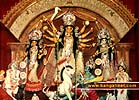
Ashtami was the sacrifice day. It was during the time when human sacrifice was common and was considered the most important part of the Puja. On its success depended the satisfaction of the Devi. It was on this day the 'Kharna' (weapon used to sacrifice) landed on the child's head, left the child unharmed. With repeated attempts the
result
remained the same. There was a commotion and when the news reached the
zamindar, he fell unconscious.
On regaining his consciousness he tearfully prayed the Goddess asking
her the reason for the omen. Durga then appeared before him and asked
him to stop sacrifices and told him she had placed her hand over the child's
neck to protect it and has wiped her hand in a cloth, which is behind
the idol. On hearing this the zamindar rushed to the mandap and found
the blood stained cloth. Henceforth, sacrifice was stopped in the Dhar
family Puja. Durga Puja took a complete social turn when it started
being organised by the common people. The word "Baroyari" is
derived from "Baro" and "Yaar" ie. a group of twelve
friends. Guptipara in Hoogly was the first place in Bengal where the idea
of "Baroyari" or "Sarbojanin" puja was concieved in
the year 1790. It took 120 yrs. for "Baroyari" Durga Puja to
reach Calcutta. The first organiser of "Baroyari" Durga Puja
in Calcutta was "Sanatan Dharmatsahini Sabha".
Overwhelming enthusiasum and participation of common people increased
the number of "Baroyari" Durga Puja through out the state.
Today we find numerous community pujas with huge funds, towering pandals
and lavish décor but sadly losing the sanctity of the whole affair.


( inside Calcutta )





GREAT INDIANS || BENGALI SECTION || BENGALI MARRIAGE || BABY'S NAME || WALLPAPER || BENGAL || WEATHER || TRAVEL
MOBILE WALLPAPER || E-CARD || MOVIE || WEBSITE LINKS || ASSOCIATIONS || SHOPPING || ASTROLOGY || MUSIC || BEAUTY CARE
TIGER || NEWS || GUEST CORNER || FEEDBACK || LINK TO US || FOR ADVERTISING || SERVICES || CONTACT || BENGALI CALENDAR
Graphics, Sound or content copied or produced in part or whole in any media will be illegal.
Persons or websites caught using our material will be penalized.
Privacy Statement || Copyright
Copyright ©1999-2014 BANGALINET.COM


