 |
| a home away from home |
| HOME FEEDBACK TELL A FRIEND WEB SITE DESIGN CAREER WITH US CONTACT US |

 Birbhum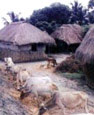
Birbhum is the northernmost District of the Burdwan Division. It lies between 23° 32' 30" and 24° 35' 0" north latitude and 88° 1' 40" and 87° 5' 25" east longitude. Its area (1,757 sq mi [4,550 sq km]) includes two separate regions. To the west lies a heaving, normally barren moorland, part of the eastern edging of the Chota Nagpur plateau, rising to 3,000 ft (900 m); to the east is a
 Home
page
Home
page
Kolkata
Burdwan
Coochbehar
Darjeeling
Hoogly
Malda
Murshidabad
Nadia
Birbhum
Dinajpur
24 parganas
Bankura
Purulia
Midnapore
Jalpaiguri

thickly
inhabited, alluvial plain of the Gangetic Delta. Birbhum is surrounded
on the north and west by Santhal Paraganas, on the east by the districts
of Murshidabad and Burdwan and on the south by Burdwan, from which it
is estranged by the Ajay River. The Ajay, Mayurakshi, Bakreswar, and Dwarka
are the foremost rivers here. Agriculture is the major activity and the
output has been at high level with the guaranteed irrigation in some part
of the district. Rice, legumes, wheat, corn (maize), and mangoes are the
principal crops in the east; coal, china clay, and iron-ore deposits are
worked in the west. The district's major industries comprise cotton and
silk weaving, rice and oilseed milling, and metal ware and pottery manufacture.
The district is proud to have Viswa Bharati at Santiniketan, the organization
established by the Great Nobel Laureate, Kabiguru Rabndranath Tagore,
in its province.
| Population | 2390 thousands (1991) |
| Temperature | Daily max. 32 C, min 21 C. |
Climate
The climate of the region is usually gentle and healthy. The hot weather
conditions typically last from the middle of March to the middle of the
June, the rainy season from the middle of June to the middle of October,
and the wintry weather from middle of October to the middle of March.
Flora
In the drier rolling country to the west the distinguishing shrubs and
herbs comprise species of Wendlandia, Evolvulus, Stipa, Tragus, Perotis,
Spermacoce, Zizyphus , Capparis and other analogous plants touching a
laterite
soil. Trees like mango, palm, and bamboo are commonly found. Other plentiful
varieties are jack, arjun, sal, piar, dhau, kend and mahua.
Fauna
The carnivores of the region included leopards, bears, wolves and other
small class. The birds usually found in the region consist of partridges,
green pigeons, and a variety of water fouls. Common birds of deltaic Bengal
are assorted up in this region with birds of wooded hill, doyel, indian
robin, drongo, hawk cuckoo, koel, sun bird, Indian roller (nilkantha),
parrot and babblers are found in profusion. The main verities of fish
comprise rui, katla are found in rivers.
Places
of Tourist Interest
Kankali Pith
It is situated in the village, Bengutia, in the station Prantik. The unique
temple is surrounded by the hot spring. Devi Kali in the appearance of
Devi Kankali is admired in this temple. This temple is believed to be
an extremely holy place by the Hindus. A festivity is also held yearly
throughout the April. Adjacent to the temple is the there runs the Kopai
River. Close to, the temples of Lord Kanchiswar Shiva and Devi Ruru Bhairav
be worthy of a visit.
Masanjore
Masanjore is a desired place for a short time tour. The Tilpara Barrage
on Mayurakshi is constructed here. The barrage at Masanjore is also identified
as Canada Dam. The barrage is 113 ft high 2000 ft long with 21 lock gates
which manage the water of Mayurakshi. The dam is enclosed by mount and
wood, and perfect spot for outing.The Massanjore Dam was built up in 1955
in Canadian support. It is 34.4 m. elevated and 609.6 m. extended. The
Mayurakshi River water is regulated with a series of 21 lock gates. Low
green hills around the Massanjore Dam join with the Birbhum's santhal,
or tribal, belt.
Bakreshwar
59 km from Shantniketan and 19 km from Suri by road, Bakreshwar is approachable
from both the places.
On the way, you may give a step over to the renowned Mama-Bhagne hill
at Dubrajpur. It appears that nature has taken ache to place the gravel
here and redecorate the set. This position is dwelling of the Oraon tribes.
You may locate numerous hilly caves; one of them somewhat renowned is
Baghsuni.
Somewhat close to, there are the temples of Pahareshwar Shiva and Shasan
Kali, according to the legend; it is worshipped by the eminent dacoit
Raghu. The Mughal Kuthi at Mahanto Para is also a significant place to
pay a visit. And the terracotta Shiva temple and Trayodash Ratna temples
are worth to visit.
Temple
of Nandikeswari
This temple was constructed in 1903. It is 179 km from Howrah. A piece
of marble, positioned in between a pipul and banyan tree, is worshipped
by the followers. There are also deities of other gods and goddesses.
A fair is arranged once a year at some time in autumn. It is thought that
the bone of the neckline of Sati cut down at Sainthia which is previously
known as Nandipur.
Fullara
Fullara is just 50 km from Bolpur linked with Nanur/ Kirnahar. The myth
is that, the lip of Sati cut down at Fullara. There is an old temple with
no deity in it. As a substitute there is a piece of tortoise-shaped rock
admired by the disciples. A fair is organized yearly in the month of Magh.
Labhpur is famous as it is the birth place of Tarasankar Bandopadhyay,
renowned novelist of Bengal. For residing here one can make contact with
the Labhpur Guest House.
There is a temple of Dharma in close by the village, Bele. Those who are
suffering from arthritis come to this village to have a bath in the pool,
adjoining to the temple which is believed to have a celestial healing
power.
Dubrajpur is a little settlement and have a Shiva temple. There are numerous huge rocks in the locality. Two significant rocks are recognized as Mama& Bhagne (Uncle & Nephew).
Hetampur
It is positioned near Dubrajpur, is well-known for the past heritage Rajbari. Here are numerous reservoirs enclosed by lofty palm trees.
8 km from Dubrajpur, the Ranjan Palace, made in the style of Hazarduari of Murshidabad is one of the chief tourist spots here, is a beautiful specimen of art and architecture. Besides the terracotta temple of Dewanji Shiva also draws the attention of the pilgrims.
Tarapith
Bakreswar
Kankalitala
Labpur
Nanoor
Joydev-Kenduli
Dubrajpur
Nalhati
Patharchapuri
Rajnagar
Hetampur





GREAT INDIANS || BENGALI SECTION || BENGALI MARRIAGE || BABY'S NAME || WALLPAPER || BENGAL || WEATHER || TRAVEL
MOBILE WALLPAPER || E-CARD || MOVIE || WEBSITE LINKS || ASSOCIATIONS || SHOPPING || ASTROLOGY || MUSIC || BEAUTY CARE
TIGER || NEWS || GUEST CORNER || FEEDBACK || LINK TO US || FOR ADVERTISING || SERVICES || CONTACT || BENGALI CALENDAR
Graphics, Sound or content copied or produced in part or whole in any media will be illegal.
Persons or websites caught using our material will be penalized.
Privacy Statement || Copyright
Copyright ©1999-2014 BANGALINET.COM


